
Inside a packaged rooftop unit
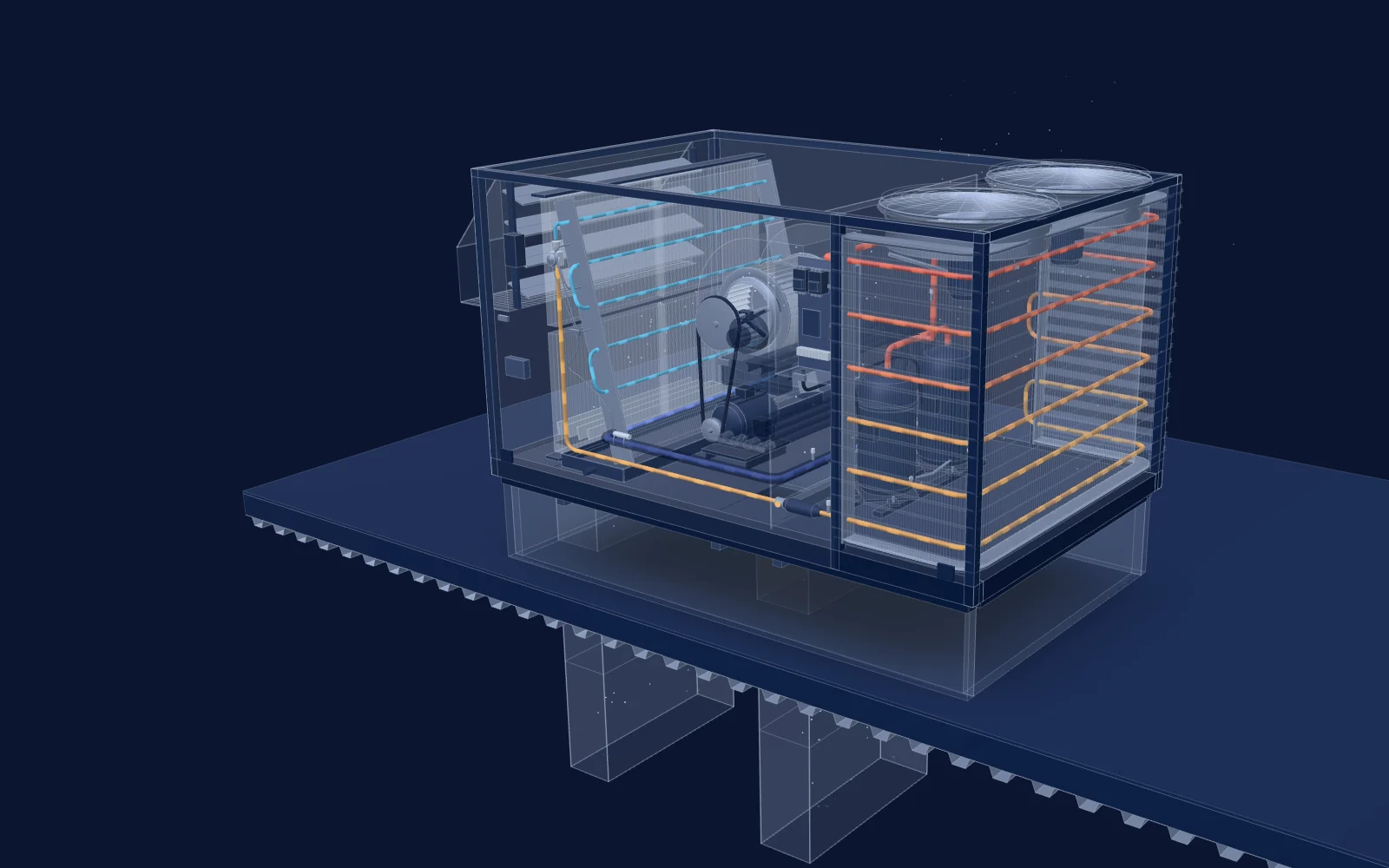
A typical RTU-1 on its curb, running a cooling call. Follow the refrigerant from the compressors round to the evaporator, and the air from the return duct to the supply.
The interactive 3D view needs WebGL, which this browser has turned off. The picture above is a still from it, and the description below covers the same ground.
RTU-1, cooling mode
This is a packaged rooftop unit on its curb, cut open so you can follow the refrigerant and the air. It's on a cooling call, so the gas heat section sits idle. Drag to turn it, or walk through the cycle one step at a time.
Illustrative design conditions · R-410A · 95°F outdoor
- Hot gas
- High-pressure liquid
- Low-pressure liquid and vapor
- Suction vapor
- Warm air
- Cooled air
Text description of the unit and the cycle
The cooling cycle
- Compression. Two scroll compressors, piped as a tandem pair, draw in suction vapor and raise its pressure and temperature. Discharge gas leaves at about 165°F and 365 psig.
- Condensing. Two condenser fans on top pull outdoor air through a U-shaped condenser coil. The hot gas gives up heat, condenses and leaves the coil as liquid at about 100°F with 10°F of subcooling.
- Expansion. The liquid line runs through a filter drier and sight glass to the thermostatic expansion valve (TXV). The TXV meters liquid into the evaporator through a distributor and drops the pressure to about 118 psig, a 40°F saturated temperature. Its sensing bulb sits on the suction line at the coil outlet.
- Evaporation. The refrigerant boils in the evaporator coil and absorbs heat from the return air. It leaves as vapor and returns to the compressors through the insulated suction line at about 50°F, 10°F of superheat.
- Air side. Return air at about 75°F comes up through the curb, mixes with a little outdoor air from the economizer, passes the filters and the evaporator, and the belt-driven blower delivers it down the supply duct at about 55°F.
Temperatures and pressures are illustrative design conditions for R-410A at 95°F outdoor, not readings from a real unit.
What our technicians check
- Refrigerant charge
- Superheat and subcooling, read at the suction and liquid service ports.
- Contactor and capacitor
- Pitted or burnt contacts and a weak run capacitor in the control panel.
- Condenser coil
- Dirt, cottonwood and bent fins that choke airflow and push head pressure up.
- Belt and bearings
- Belt wear and tension, sheave alignment and bearing noise on the blower.
- Filters
- Loading and fit in the filter rack.
- Economizer
- Damper linkage and actuator, and whether it actually modulates.